
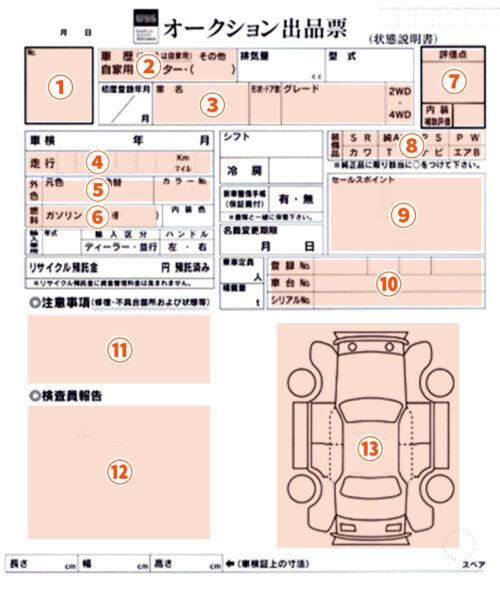
A Japanese car auction sheet (出品票 / Shuppinhyō) gives you a quick look at a vehicle’s condition before you bid.
Auction inspectors evaluate the vehicle independently, checking its condition, damage, mileage, repair history, and equipment. While grading systems can vary between auctions, the basic information is generally similar.
Once you know what to look for, reading an auction sheet becomes much easier.
🔍 What Information Is on an Auction Sheet?
Here are the key sections you should check:
| Item | What It Tells You |
|---|
| Auction Number | Identifies the vehicle in that auction. |
| Make & Grade | Shows the model, trim, and specifications. |
| Mileage | Displays the recorded mileage and may indicate mileage concerns. |
| Exterior Color | Shows the vehicle’s original/current color. |
| Fuel Type | Gasoline, diesel, EV, etc. |
| Auction Grade | Gives an overall indication of the vehicle’s condition. |
| Equipment | Lists features such as sunroof, alloy wheels, navigation, etc. |
| Selling Points | Highlights notable features or aftermarket parts. |
| Inspector’s Comments | Provides details about damage, repairs, and other concerns. |
| Damage Diagram | Shows where scratches, dents, rust, and other damage are located. |
| Vehicle/Chassis Number | Helps identify and verify the vehicle. |
👉 Don’t rely on the auction grade alone. Always check the inspector’s comments and damage diagram.
🧾 Understanding Auction Grades
The grading system varies by auction, but the following is a general guide to commonly used Japanese auction grades:
| Grade | General Condition |
| S / 6 | Very good condition, usually low mileage and minimal damage. |
| 5 | Excellent condition with only minor imperfections. |
| 4.5 | Very good condition with minor repairs or imperfections possible. |
| 4 | Good overall condition, but some repairs or reconditioning may be needed. |
| 3.5 or below | More noticeable damage or repairs may be required. |
| R | Vehicle with a repair history involving structural areas. |
| X | Special vehicles that may not receive a standard grade. |
💡 Important: A high grade does not guarantee a perfect vehicle. The inspector’s comments, damage diagram, mileage, and repair history are equally important.
🪶 Interior Condition Grade
The interior is usually graded separately:
- A – Very clean; only minor imperfections.
- B – Good condition, but some cleaning or minor repairs may be needed.
- C – Noticeable stains, tears, or other damage.
- D – Significant damage or restoration required.
- E – Extensive interior damage or noticeable odors.
Tip: Check the interior photos and inspector’s comments along with the grade.
🔧 Understanding Damage Symbols
The damage diagram helps you quickly see where and how serious the exterior damage is.
Common symbols include:
- A1–A3 → Scratches
- E → Small dents/dings
- U1–U3 → Dents
- S1–S3 / C1–C3 → Rust or corrosion
- Y1–Y3 → Cracks or breaks
- W1–W3 → Repair marks
- XX → Replaced parts
Generally, a higher number indicates more significant damage, but always check the auction’s specific grading standards.
💡 Why the Auction Sheet Isn’t Enough?
Two vehicles can have the same auction grade but very different actual conditions.
One Grade 5 vehicle might be exceptionally clean, while another may have imperfections that are easy to miss if you only look at the grade.
That’s why a professional pre-auction inspection (shita-mi) can be valuable. A physical inspection can confirm details that may not be obvious from the auction sheet or photos.
🚘 Need Help Choosing a Japanese Used Car?
Understanding an auction sheet takes experience. If you’re unsure about:
- Which vehicle to choose
- What the auction grade means
- Whether the damage is serious
- What to check before bidding
- How to export the vehicle to Guyana
We’re here to help.
We can support you with vehicle selection, auction-sheet analysis, pre-auction inspections, bidding, and export arrangements based on your needs and budget.
The better you understand the auction sheet, the better your purchasing decision can be.

コメント